


To define curls, choose a styling method that helps your natural texture form the shape you want, then give that style a chance to set. Start with a manageable routine, compare your dry results, and adjust one thing at a time. More definition doesn’t have to mean more products or a longer wash day.
Let’s get something out of the way: your curls don’t have to look like someone else’s tutorial to look good. Maybe you want bigger curl groups. Maybe you want a little more shape around your face. Maybe you love volume and just want the ends to look more intentional. Those are different goals, and your routine gets to reflect that.
First, what do you want your curls to do?
“More defined” sounds simple until you try to describe it. Take a minute to be specific. Are you looking for more visible curl groups, a tidier finish, or more consistent styling around your face? Start with one goal so you can recognize progress.
You can like some softness and still want definition. You can like fullness and still use a defining tool. This isn’t an exam where one perfect curl pattern earns the highest score.
Build a routine you’d actually repeat
Keep the preparation familiar
Use your normal wash routine as the baseline, following the directions on your products. If you change everything at once, the results become a guessing game. Keep a quick note of what you used so you can repeat the combination you liked.
For foundational care, the American Academy of Dermatology recommends conditioner after washing, gentle detangling, and absorbing moisture without rough towel rubbing. Styling comes after that basic care; a defining technique shouldn’t require fighting through tangles.
Decide how much styling time you want to spend
Be honest with yourself here. Do you want an everyday routine, or are you happy to spend extra time for an occasion? A method that looks lovely but makes you dread every wash is probably asking too much.
Start with the simplest version you’re willing to repeat. You can always add a little detail later. You can also give more attention to visible sections and keep the rest of your routine straightforward.
Follow the instructions on your styling products
You don’t need a universal product stack from the internet. Use what fits your hair and the finish you enjoy. Look at the application directions rather than assuming every cream, gel, or mousse belongs at the same stage.
If you suspect your routine feels too heavy or too complicated, simplify your next test rather than immediately adding something else. Your notes will help you connect an adjustment with a result.

Choose a styling method that fits your goal
| Approach | Why you might try it | What to notice |
|---|---|---|
| Your usual hands-only styling | You want a familiar, minimal-tool starting point. | Which areas already form the shape you like? |
| Brush styling | You want more deliberate shaping of prepared sections. | Can you work comfortably, and do you prefer the dry result? |
| A combination | You want detail in selected areas without a full-head routine. | Where does the extra effort make a difference to you? |
You don’t have to declare lifelong loyalty to one technique. Use a combination if that fits your morning better. A routine is something you can adapt, not a set of rules you have to obey.
For a tool-based method, our Curl Training Guide demonstrates the brand’s section-by-section approach. Here, “curl training” describes a styling method, while “curl definition” describes the look you’re working toward.

When your curls aren’t doing what you hoped
“They look different on each side.”
Compare how you worked on each side before you change products. Was one side harder to reach? Did you rush it? Did you use the same amount of styling attention? A photo and a quick note can help you spot a pattern in your routine.
“I got definition, but I don’t love the overall shape.”
That’s useful feedback. More visible curl groups aren’t automatically your favorite style. Decide whether your next attempt should prioritize fullness, a softer finish, or less detailed styling. Your preference matters more than copying a reference photo.
“I keep adding products because something looks off.”
Pause the shopping list. Pick one question for your next wash: does a simpler routine feel better? Do I prefer hands-only styling in some areas? Am I judging the style before it’s finished drying? A focused experiment is easier to learn from.
“Nothing seems to work.”
A tutorial can help you experiment, but it can’t assess your hair in person. A stylist familiar with your texture can help you evaluate technique and shape. If the issue includes ongoing breakage, hair loss, or scalp symptoms, seek individual professional advice.
Where a curl defining brush fits
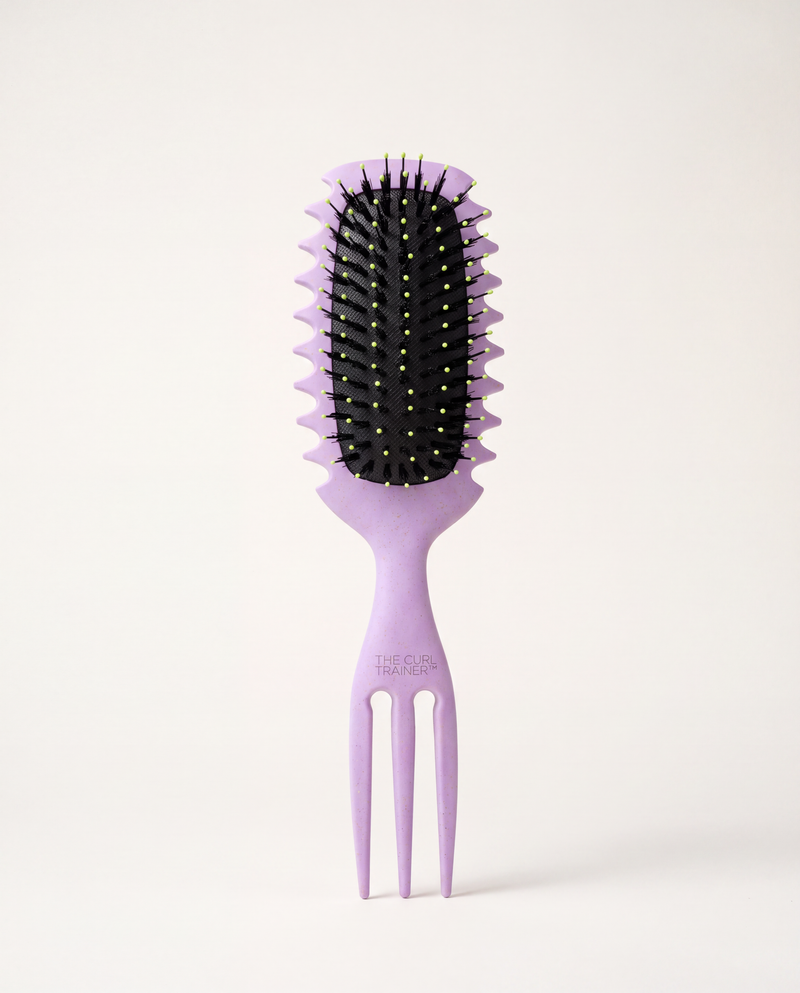
A brush is an option within the routine, rather than the entire routine. If you’d like to explore ours, The Curl Trainer® PRO Curl Defining Brush has a product page with feature details and usage guidance. Decide whether its approach suits your preferences before adding another tool.
If you’re new to the technique, use the linked guide and test one area. You don’t owe a new tool a whole-head experiment on a day when you’re already running late.

Your next wash-day experiment
Choose a goal, keep your preparation familiar, and try one method you can describe clearly. Take a photo after drying and write one sentence: “Next time, I want more…” or “I’d keep…” That’s a routine you can learn from.
Some days you’ll want more definition. Other days you’ll want your hair up and your coffee ready. Both can belong in the same curly-hair life.
A few questions you might be asking
How do I define curls without using a brush?
Start with your familiar hands-only styling method and compare the dry result. You can explore how you arrange individual sections without committing to a brush-based routine.
Do I need a curl defining brush?
No. It is one styling option. Consider one if you want to explore shaping sections with a tool and can use it comfortably.
Are curl definition and curl training the same thing?
In this guide, definition is the appearance you want. Curl training refers to the brand’s styling method for working with your existing texture.
Should all my curls look identical?
No. Choose the finish and overall shape you enjoy rather than using identical curls as your measure of success.

